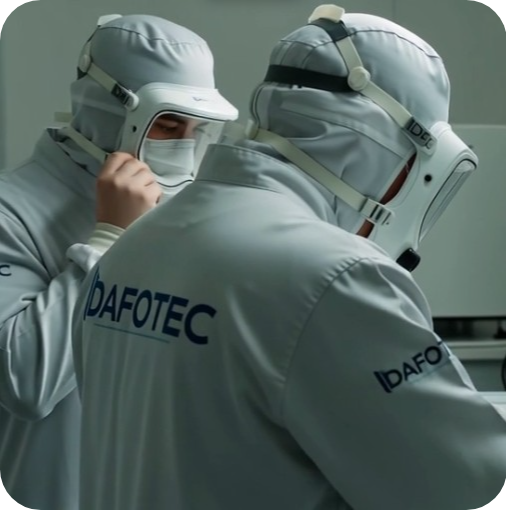
The previous chapters described the what (anatomy), the why (diagnosis) and the how (methods). What remains is the organization that turns this knowledge into a success rate: a lab is a chain of controlled steps, where each link protects the next.
1 · Intake & traceability
On arrival, each device gets a unique identifier and a record: origin, described symptoms, priority data, urgency level. This traceability, which follows the device through to return, is the basis of serious handling — and essential in a legal context.
2 · The ISO 5 cleanroom
Opening a hard drive exposes its platters to ambient air, where a single dust particle can cause a head crash. The ISO 5 cleanroom keeps air below 3,520 particles of 0.5 µm per m³ — about a thousand times cleaner than an ordinary room — through HEPA filtration and positive pressure. Head transplants, platter swaps and work on bare platters are only performed there, under laminar flow.
3 · The imaging bench
Once the device is stabilized, it moves to the imaging bench: multi-port imagers (PC-3000, DeepSpar, Atola), write blockers, controlled power. This is where the working copy is born, sector by sector, sealed by its SHA-256 hash. From this point, the original can be set aside: everything happens on the image.
4 · The donor stock
A head transplant or PCB swap requires a strictly compatible part: same model, same revision, sometimes same manufacturing week. Dafotec keeps a stock of over 20,000 parts (drives, boards, heads) that avoids sourcing delays and increases the chance of finding the exact donor. This stock is an asset as decisive as the tools.
5 · Reconstruction & verification
On the copy, we apply the logical methods: file-system reconstruction, RAID de-striping, data carving. Each recovered file is then verified: opened, checked for integrity. The result is compiled in the VeriFiles list, an exhaustive inventory the client approves before any payment — the embodiment of "no data – no fee".
6 · Return & erasure
The approved data is returned on a new encrypted device. At the end of the mission, and after client confirmation, the working copies are erased in a certified way: no data remains in the lab. For sensitive cases, a destruction certificate is provided. The loop is closed, from symptom to oblivion.